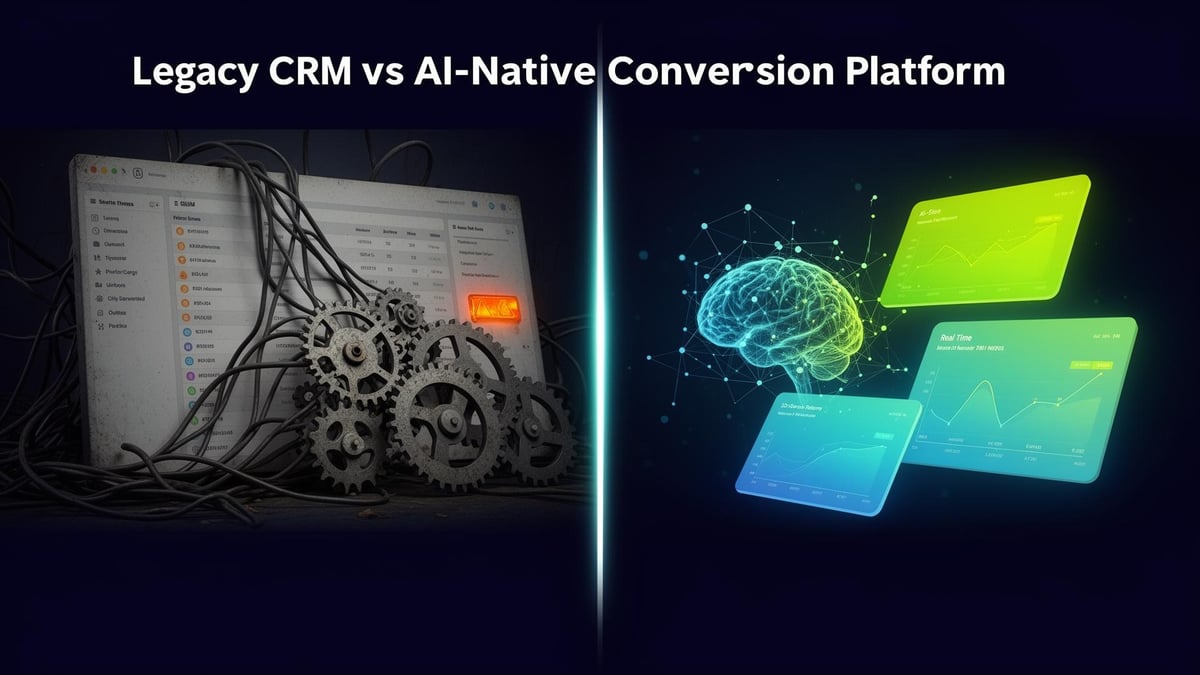
- The Data Nobody Wants to Talk About
- What Legacy CRM Platforms Actually Do (and Don't Do)
- The Real Total Cost of Ownership
- What AI-Native Conversion Actually Means
- Side-by-Side: Legacy CRM vs AI-Native Conversion
- The Zero-Leakage Framework
- Why WhatsApp-First Architecture Matters in India
- What This Means for OEMs and Dealer Networks
- Frequently Asked Questions
The Data Nobody Wants to Talk About
The Indian automotive industry spends thousands of crores annually on digital lead generation. Google Ads, Meta campaigns, auto expos, dealer events, OEM brand activations. The machinery of top-of-funnel marketing is well-funded and operationally mature.
The uncomfortable truth is what happens next.
The funnel isn't broken at the top. It's hemorrhaging in the middle — between "lead captured" and "showroom visit booked." This is the gap that legacy CRM platforms were supposed to solve. Most haven't.
What Legacy CRM Platforms Actually Do (and Don't Do)
Enterprise CRM platforms — the ones deployed across most large OEM and dealer networks — were architected for a specific purpose: data management. They store contact records, track pipeline stages, generate reports for management, and integrate with other enterprise systems.
What they were not built to do is act on data autonomously.
Consider the typical workflow in a dealership running a legacy CRM stack. A lead comes in from a digital campaign. The CRM captures the record. A BDC coordinator sees the lead in a queue. They prioritize based on recency or gut instinct. They attempt a call. If the buyer doesn't answer, the lead sits in a follow-up queue that grows longer every day.
Meanwhile, 70% of the sales floor is tracking leads on personal WhatsApp accounts and handwritten notebooks. The CRM becomes a reporting tool for management — not a selling tool for the people who actually convert leads.
70% of dealership sales teams track leads on personal WhatsApp — not in the CRM their OEM mandated and paid lakhs to deploy.
This isn't a training problem. It's an architecture problem. Legacy CRMs ask humans to feed the system. AI-native platforms feed the humans — and handle the 80% of tasks that don't require human judgment in the first place.
The Real Total Cost of Ownership
The sticker price of an enterprise CRM license is misleading. When an OEM evaluates a platform, the per-user licensing cost is only the beginning. The real financial picture includes integration middleware, marketing automation add-ons, support contracts, training programs, dedicated admin headcount, and the opportunity cost of a 2–6 month deployment timeline.
What the all-in cost actually looks like
For a major enterprise automotive CRM deployment, the base licensing often starts around $325 per user per month. However, when you factor in the integration layer, marketing cloud modules, administrative overhead, and ongoing customization, the true cost typically runs between $780 and $1,250 per user per month. For a dealer network of any meaningful scale, this adds up to a significant annual commitment — often running into crores.
More critically, every week of deployment delay equals leads decaying in the pipeline. If it takes 4 months to go live, that's 16 weeks of leads being handled by the same broken process the new system was supposed to fix.
AI-native platforms operate on a fundamentally different cost model. Deployment is measured in days, not months. The system doesn't require a dedicated admin team because the intelligence is built into the architecture. And the ROI is measured not in "CRM adoption rates" but in actual conversion improvements.
What AI-Native Conversion Actually Means
The term gets overused, so let's be precise. An AI-native conversion engine is a platform where artificial intelligence isn't a feature bolted onto a database — it is the core operating architecture.
This distinction matters enormously in practice.
Legacy CRM with AI features
A traditional platform adds predictive lead scoring on top of its existing data model. It shows a salesperson which leads are "hot." But the salesperson still has to make the call, write the WhatsApp message, and log the outcome. The AI assists. The human still does the work.
AI-native conversion engine
The platform receives a lead and acts on it autonomously within minutes. It initiates a personalized, context-aware conversation on WhatsApp. It schedules and executes voice follow-ups. It scores intent continuously — not at the moment of capture, but based on ongoing behavioral signals. It routes the lead to the right salesperson at the right time, with full context. The human's job is to close. Everything upstream is automated.
This is not a CRM upgrade. It's a fundamentally different category of software.
Side-by-Side: Legacy CRM vs AI-Native Conversion
| Dimension | Legacy CRM Platform | AI-Native Conversion Engine |
|---|---|---|
| Core function | Manages leads through stages | Converts leads autonomously |
| Operational mode | Tracks what happened | Makes things happen |
| Deployment time | 2–6 months | Days to go live |
| All-in cost | $780–$1,250/user/month | Fraction of the cost |
| Follow-up | Humans do the follow-up | AI does the follow-up |
| Primary channels | Email and SMS first | WhatsApp and Voice first |
| Lead scoring | Point-in-time at capture | Continuous, behavior-driven |
| WhatsApp integration | Third-party add-on required | Architecturally native |
| Vehicle configuration | No native CPQ | Built into the conversation flow |
| Success metric | CRM adoption rate | Revenue conversion rate |
The Zero-Leakage Framework
Traditional funnels are designed with exits at every stage. Leads enter at the top, and at each step — qualification, first contact, follow-up, showroom booking — a percentage falls out. Nobody measures the cumulative leak. The industry accepts 2–4% conversion as normal.
The Zero-Leakage framework operates on a different principle: no lead is ever abandoned without exhausting every channel and every reasonable attempt.
How it works architecturally
Instant intelligent response. Every lead gets a personalized, context-aware interaction within 2 minutes of capture. Not a template. Not an autoresponder. An actual conversation driven by AI that understands the buyer's intent, the vehicle they enquired about, and the dealership they're routed to.
Multi-channel sequencing. Follow-up moves through WhatsApp, then voice, then email — in that order. The sequence is determined by buyer behavior, not by a static cadence programmed months ago. If a lead opens a WhatsApp message but doesn't respond, the system adjusts its timing and approach.
Continuous intent scoring. A lead marked "cold" on Monday might be "warm" by Thursday based on website revisits, WhatsApp message engagement, or voice call pickups. The system re-evaluates intent continuously, not at a single point in time.
Intelligent routing. When a lead is ready for human engagement, it's routed to the right salesperson — not the next person in a round-robin queue, but the one whose skills, location, and availability make them the best fit for that specific buyer.
2–3x conversion improvement vs industry benchmark — not because the platform generates better leads, but because it loses fewer.
Why WhatsApp-First Architecture Matters in India
97% of smartphone users in India have WhatsApp. It is the default communication channel for personal and, increasingly, commercial interactions. The average Indian car buyer researches online, shortlists 2–3 brands, and expects instant, conversational engagement from the brands they're considering.
Most dealerships respond with an email template and a PDF brochure. Or a call from an unknown number during working hours.
The channel mismatch is staggering. WhatsApp messages achieve 85–95% open rates compared to 15–20% for email. Response rates are 3–5x higher than SMS. And the buyer decision window in Indian automotive is typically 2–4 weeks from first enquiry.
For a conversion platform, WhatsApp can't be an integration. It has to be the architecture. The entire conversation flow — from first response to appointment booking to pre-visit information — needs to live natively in WhatsApp, powered by AI that can handle context, personalization, and multi-turn conversations at scale.
Legacy platforms treat WhatsApp as a notification channel. AI-native platforms treat it as the primary conversion channel.
What This Means for OEMs and Dealer Networks
The shift from legacy CRM to AI-native conversion isn't a technology upgrade. It's a category change. And it has implications across the entire automotive marketing and sales chain.
For OEM brand teams: the metric that matters shifts from cost-per-lead to cost-per-showroom-visit. Media allocation starts reflecting conversion efficiency at the dealer level, not just lead volume at the campaign level. OEMs gain real-time visibility into what happens after the lead is routed — dealer response times, follow-up quality, conversion rates by location.
For dealer groups: the BDC model evolves. Instead of 15–20 coordinators manually working through lead lists, the team shrinks to 5–7 people focused on complex, high-intent interactions — while AI handles the volume. The result is higher conversion per salesperson and lower operational overhead.
For the industry: the brands that operationalize AI-native conversion in 2026 will have a 12–18 month head start. The brands waiting for industry-wide adoption will be playing catch-up well into 2027.
Ready to see what Zero-Leakage looks like?
Swiftex is the AI-native conversion engine built for automotive OEMs and dealer networks. WhatsApp-first. Autonomous follow-up. Deployed in days.
Book a Demo →Frequently Asked Questions
What is the difference between a legacy CRM and an AI-native conversion engine?
A legacy CRM stores and organizes lead data for humans to act on. An AI-native conversion engine autonomously acts on leads — following up via WhatsApp, voice, and email within minutes, scoring intent continuously, and routing leads intelligently — without waiting for human intervention.
Why are automotive dealers moving away from enterprise CRM platforms?
Common pain points include high total cost of ownership (often $780–$1,250/user/month all-in), 2–6 month deployment timelines, no native WhatsApp integration, lack of autonomous lead follow-up, and CRM fatigue at the dealer level where the majority of sales teams default to personal WhatsApp and notebooks.
What is a Zero-Leakage funnel in automotive lead management?
A Zero-Leakage funnel is an AI-driven architecture where no lead is ever abandoned. Every lead receives an intelligent response within 2 minutes, intent scoring runs continuously, follow-up cadences are AI-driven across WhatsApp, voice, and email, and no lead is marked dead without exhausting all channels.
How much does a legacy automotive CRM cost compared to AI-native platforms?
Enterprise legacy CRM platforms can cost $780–$1,250 per user per month when factoring in integration tools, marketing automation add-ons, support contracts, and admin headcount. AI-native conversion platforms typically deliver superior conversion outcomes at a fraction of this cost with deployment in days rather than months.
Why does WhatsApp-first matter for automotive lead conversion in India?
97% of Indian smartphone users are on WhatsApp, with 85–95% message open rates compared to 15–20% for email. The average car buyer in India makes a purchase decision within 2–4 weeks. Reaching them on WhatsApp with an intelligent conversation — not a template blast — within minutes of their enquiry dramatically improves conversion.