|
<2s |
0 |
5,000 |
Unlimited |
|
First outbound message from form submit |
Leads lost during rolling deploys |
Leads/min absorbed without response lag |
Horizontal scale, no sticky sessions |
|
In this article 1. The Real Reason the 5-Minute Gap Exists 2. The Architecture Shift: Leads as Events, Not Records 3. How Swiftex Routes a Lead in Real Time 4. Prioritized Queues That Always Put the New Lead First 5. How Swiftex Stays Fast at Any Scale 6. What This Looks Like in Numbers 7. The Takeaway for Revenue Teams 8. Frequently Asked Questions |
The Real Reason the 5-Minute Gap Exists
If you have ever watched a freshly submitted lead sit untouched for five minutes, or fifteen, the instinct is to blame the team. Too slow. Not paying attention. Understaffed.
But in most cases, the team is not the problem. The architecture is.
Here is what actually happens in a traditional CRM flow when a lead comes in:
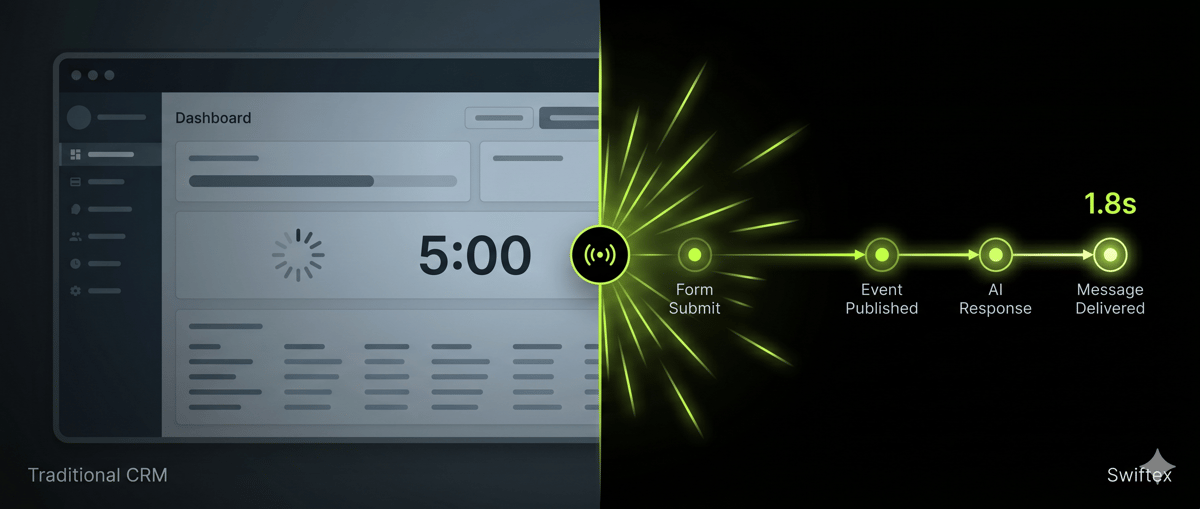
A form is submitted >> it writes to a database >> a polling job wakes up on a scheduled interval >> it picks up the record >> it hands off to an assignment queue >> an agent assignment process runs >> the lead finally lands in a workflow.
Each of those steps is a synchronous handoff. A database commit waiting for a poll. A poll waiting for a batch window. A batch window waiting for an assignment rule to resolve. The five-minute gap is not an outlier. It is the natural accumulation of handoffs in a system that was built to process records, not react to events.
The lead does not know it is in a queue. The customer does not know they are waiting in a batch window. They just know no one reached out. And in high-intent verticals like banking, fintech, automotive, real estate, and insurance, that window is where decisions get made. Usually in favor of whoever showed up first.
|
The Architecture Shift: Leads as Events, Not Records
The core insight that drives Swiftex's response infrastructure is deceptively simple:
A lead is not a record to be processed. It is an event to be reacted to.
That one reframe changes everything downstream.
When a lead is treated as a database record, the default behavior is polling -- systems periodically asking "did anything new come in?" When a lead is treated as an event, the default behavior is reaction -- systems that are already listening fire the moment something happens.
Swiftex's lead infrastructure is built on this reactive backbone. The moment a lead is captured, from a website form, an ad platform, a partner API, or a third-party aggregator, the lead service publishes an event immediately. Not to a database row waiting to be polled. To a message bus that downstream services are already subscribed to.
The result: the first outbound message workflow, including AI greeting generation, WhatsApp delivery, and SMS fallback, begins within the same second the lead arrives. No polling interval. No batch window. No assignment delay.
How Swiftex Routes a Lead in Real Time
Event-Driven Routing
At the center of Swiftex's real-time pipeline is an event-driven routing architecture using RabbitMQ, a message broker designed specifically for high-throughput, reliability-critical workloads.
Here is what happens the moment a lead is captured:
- The lead service publishes an event containing the lead identifier, source, campaign context, and routing metadata to a topic exchange. This happens in milliseconds.
- Downstream services subscribe only to what they need. The conversation engine, analytics pipeline, and CRM sync each listen for the routing keys relevant to them. They receive the event in parallel, not one waiting on another.
- The lead service's job is done. The moment the event is on the wire, the lead service has finished its work. Engagement happens reactively from that point forward.
This architecture gives Swiftex three capabilities that directly impact conversion:
- No lead is silently dropped. If a consumer service is mid-deploy, briefly unreachable, or restarting after an update, events queue in the broker. They do not disappear. The lead will be processed the moment the service is back, without any manual intervention.
- Parallel fan-out instead of sequential handoffs. The same lead-created event simultaneously triggers the conversation engine, updates the analytics pipeline, and syncs to the CRM. These happen in parallel, not in a chain where each step waits for the previous one.
- Transient hiccups do not block the pipeline. Automatic reconnection and message buffering at the publisher level mean a brief broker disruption never holds up the API request that originated the lead.
- Initial greetings run at highest priority. The customer who just submitted a form is always at the front of the line.
- Follow-ups run at lower priority. They are scheduled, not urgent.
- Status syncs run at lowest priority. Background work that does not block the customer path.
- Exponential backoff with capped retries. When third-party APIs such as WhatsApp Cloud API and LLM providers occasionally rate-limit or time out, the queue retries with widening intervals instead of hammering a degraded upstream. A transient API failure becomes a brief delay, not a dropped message.
- Delayed jobs as first-class primitives. Follow-ups, inactivity timeouts, and session expiry schedules are built directly into the queue as delayed jobs. There are no CRON jobs to maintain, no polling loops that die with a process restart, no setTimeout calls that disappear when a server goes down.
- Shared queue backbone. Every BullMQ worker, on any instance in any region, can pick up any job. Scaling capacity is as simple as adding more workers. No sticky sessions, no instance affinity, no requirement that a lead be handled by the same server that received it.
- Distributed idempotency. Every inbound webhook and every consumed event passes through an idempotency service that fingerprints the message and checks Redis. If the same WhatsApp delivery receipt arrives twice, only the first drives a state change. Without this, at-least-once delivery quietly becomes at-least-once duplicate messages to the customer.
- Inbound message buffering across instances. The debounce window lives in a Redis list keyed by session. The flush worker, wherever it runs, sees the complete message burst, not just the slice that hit its particular instance. This makes conversational coherence possible at horizontal scale.
- Consistent rate-limit and session state. Per-session and per-organization counters stay consistent across all instances via pooled Redis clients, with an in-memory fallback if Redis briefly drops.
Prioritized Queues That Always Put the New Lead First
Routing a lead to the right place in real time is only half the problem. The other half is executing the actual outbound work, including AI greeting generation, WhatsApp Cloud API delivery, SMS fallback, and follow-up scheduling, reliably, at scale, with no degradation under load.
Swiftex handles this with BullMQ, a prioritized job queue system backed by Redis.
How the Queue Works
Every outbound task lands in a dedicated queue with an assigned priority level:
This means a campaign generating 5,000 leads in 60 seconds does not starve the first-response path. The new lead and the 5,000th lead are both queued and processed without degradation. Priority rules keep the customer experience consistent regardless of traffic volume.
Three Patterns That Make the Queue Production-Grade
How Swiftex Stays Fast at Any Scale
Speed at one lead per minute is easy. Speed at 5,000 leads per minute, across multiple campaigns, multiple channels, and multiple instances, is an infrastructure problem.
Swiftex's lead service and conversation service both run horizontally scaled, with multiple instances behind a load balancer. The coordination layer that keeps them coherent is Redis.
The practical outcome: when traffic spikes, the response is to bring up more workers. Nothing breaks, no session state is lost, and response latency stays consistent for lead one and lead five thousand.
What This Looks Like in Numbers
These are not theoretical benchmarks. They are the properties of the production architecture:
|
Metric |
What it means for your pipeline |
|
< 2 seconds first message |
From form submit to AI greeting delivered, including event publish, consumer execution, AI generation, and channel API delivery |
|
Zero lead loss during deploys |
Events queue while consumers restart; they resume cleanly without manual intervention |
|
5,000 leads/min without degradation |
Campaigns that burst do not impact response time for any individual lead in the queue |
|
Deduplication at every hop |
The same lead arriving from two sources does not create two contacts or two outreach threads |
|
Coherent conversations under typing bursts |
Debounce windows collect rapid messages into a single coherent AI turn |
The Takeaway for Revenue Teams
The 5-minute gap is not a "we need faster people" problem. It is almost never about agent effort or team discipline.
It is a synchronous handoff problem disguised as a speed problem.
Polling jobs, batch windows, scheduled syncs, and manual assignment rules are each individually reasonable. Together, they compound into a pipeline that structurally cannot react in real time, no matter how motivated the team is.
Replacing those handoffs with events, prioritized queues, and shared state coordination turns first-response time from a bottleneck into a competitive lever. Not incrementally. Structurally.
When the architecture reacts, the team can focus on the conversations that matter, not on fighting the lag that the infrastructure created.
|
Frequently Asked Questions
Why does the 5-minute lead response gap exist in most CRMs? +
The delay is an architectural byproduct of systems built to process records rather than react to events. Traditional CRM flows rely on database writes, polling jobs, batch windows, and sequential assignment handoffs, each adding latency. The 5-minute gap is the cumulative result of synchronous handoffs, not slow code. Replacing those handoffs with event-driven architecture is the only structural fix.
What is event-driven lead routing and why does it matter? +
Event-driven routing treats a lead submission as an event rather than a database record. The moment a lead is captured, a message is published to a broker that downstream services are already subscribed to. This eliminates polling intervals and batch windows, enabling the first outbound message to fire within the same second the lead arrives, rather than after the next scheduled processing cycle.
How does Swiftex ensure no lead is lost during system updates or restarts? +
Swiftex uses durable, persistent message queuing. If a consumer service is mid-deploy or briefly unreachable, events queue in the broker rather than disappearing. The moment the service restores, it processes the queued events. No lead requires manual recovery or re-triggering.
What is BullMQ and how does it affect lead response priority? +
BullMQ is a Redis-backed job queue that allows Swiftex to assign priority levels to different outbound tasks. Initial greetings run at the highest priority, ensuring that new leads are always processed first regardless of traffic volume. Follow-ups and background syncs run at lower priority. This means a burst of 5,000 campaign leads does not degrade response time for any individual lead.
How does Swiftex handle duplicate leads from multiple sources? +
Every inbound webhook and message event passes through a distributed idempotency layer backed by Redis. Each message is fingerprinted and checked before processing. If the same lead arrives from two sources, or the same event is delivered twice, only the first drives a state change. This prevents duplicate contacts, duplicate outreach threads, and corrupted attribution data.
Can Swiftex maintain conversational coherence when a lead sends multiple rapid messages? +
Yes. Swiftex uses debounce windows in the job queue, a short delay that collects rapid successive messages into a single AI turn before generating a response. If a customer sends three messages in three seconds, the AI sees the complete context and responds once, coherently. This applies consistently across all horizontally scaled instances via shared Redis session state.
See every lead.
Respond before the competition does.
Swiftex routes, qualifies, and engages every lead in under 2 seconds across WhatsApp, voice, and email. Every channel. Zero leakage.