In This Article
01 Where dealership lead management breaks down
02 What AI lead prioritization actually does
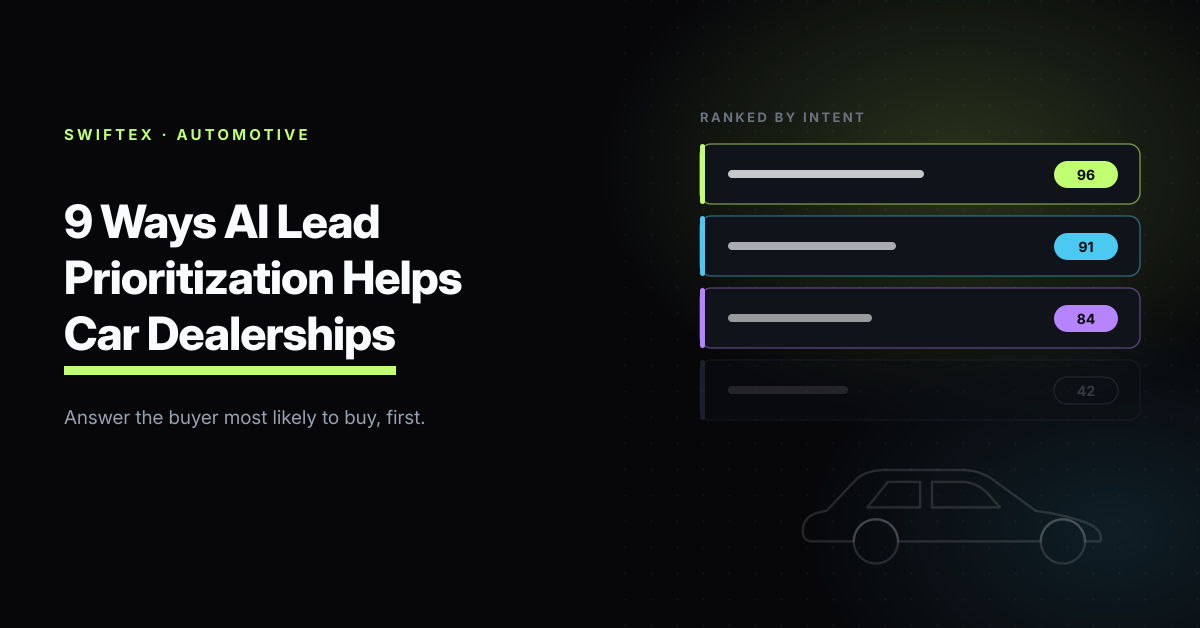
03 Ranks enquiries by buying intent, not arrival time
04 Answers the highest-intent buyers inside a minute
05 Separates finance-ready buyers from early researchers
06 Routes each lead to the right showroom and advisor
07 Protects test drive slots and advisor calendars
08 Closes the leakage after day three
09 Scores the WhatsApp conversation, not just the form
10 Turns exchange and finance enquiries into ranked deals
11 Gives OEMs and dealer groups one view of lead quality
12 What to measure in the first 90 days
13 Frequently asked questionsWhere dealership lead management breaks down
The gap is rarely marketing spend and rarely buyer intent. It is the stretch between an enquiry landing and someone deciding what to do with it.
- Indian buyers arrive pre-shortlisted. Google research with Kantar TNS found 90 percent of car buyers in India research online before visiting a dealership, and 65 percent keep researching on their phones inside the showroom.
- Dealership visits per purchase have fallen from four to two, so one slow response can remove you from the shortlist entirely.
- Response speed is improving industry-wide, which raises the bar. Pied Piper’s 2026 Internet Lead Effectiveness study of 3,290 dealership websites put the industry average at 71 out of 100, up six points, with 62 percent of stores now using call and text together against 49 percent a year earlier.
- Automation alone is not the answer. The same study found dealership response quality fell by around nine points when an enquiry needed genuine human involvement.
The losses cluster in the mid-funnel: slow call-backs, broken WhatsApp threads, missed finance follow-ups, stale exchange quotes, and blind dealer handoffs. Each one is a door the buyer walks out of.
What AI lead prioritization actually does
It scores every enquiry on probability of retail, then sets the order, owner, channel and deadline for follow-up across the whole mid-funnel. Lead scoring produces a number. Prioritization acts on it, and it acts at every stage between enquiry and showroom: instant reply, qualification, test drive, finance and exchange, then an enriched handoff to the advisor. Typical dealership signals include:
- Variant and colour pages viewed, repeat visits inside 48 hours
- EMI or on-road price calculator use, brochure downloads, test drive form starts
- Exchange enquiry, odometer and photo intake, finance document uploads
- City and pin code against dealer territory, inventory availability, source quality history
- Content of the first WhatsApp reply, plus voice call duration and disposition
This is the layer Swiftex builds for OEMs and dealers, sitting on top of the CRM and DMS already in place rather than replacing them.
9 ways AI lead prioritization helps car dealerships
1. Ranks enquiries by buying intent, not arrival time
A first-in-first-out queue treats last night’s repeat EMI calculation the same as a brochure download from another state.
- Demand intelligence scores intent, persona and timeline at the moment of capture
- Advisors open a ranked list of twenty names instead of a queue of two hundred
- Sequencing stops depending on who opens the CRM first
2. Answers the highest-intent buyers inside a minute
Speed is expensive to apply evenly and cheap to apply selectively. The Lead Response Management research popularised through Harvard Business Review found qualification odds drop sharply once the first hour passes.
- A sub-minute first reply on WhatsApp or voice becomes a routing decision, not a staffing decision
- The top-scoring band gets a live conversation, everything below runs on an automated cadence
- After-hours and weekend enquiries stop waiting for Monday
3. Separates finance-ready buyers from early researchers
Two enquiries for the same variant can be four months apart in purchase timing, and the form does not tell you which is which.
- EMI queries, pre-approval interest, KYC document uploads and delivery timeline questions mark near-term buyers
- Comparison content and competitor model views mark buyers eight to sixteen weeks out
- The first group reaches an advisor, the second stays in structured nurture until the signals change
4. Routes each lead to the right showroom and advisor
Routing decides who works the lead, and that choice moves close rates as much as sequencing does. Assignment logic can weigh brand, city, showroom and advisor together:
- Live inventory and variant availability at the nearest outlet
- Advisor close rate on that model and source, current pipeline and shift
- Language preference, which decides the outcome in vernacular markets
- Handoff carries the intent score, model preference, budget and full transcript, so no advisor starts blind
5. Protects test drive slots and advisor calendars
Demo vehicles, test drive slots and advisor hours are the most expensive assets in the funnel.
- High-scoring buyers get weekend and evening slots booked directly into real advisor calendars
- Lower-scoring enquiries get mid-week windows or a home test drive
- Confirmations, reminders and reschedules run automatically, which is where show-up rates move
6. Closes the leakage after day three
Follow-up at most stores is heaviest on day zero, thins by day two and stops by day five, regardless of what the buyer is doing.
- Continuous re-scoring pushes a revived lead back up the list with the reason attached
- Advisors get a short daily revival list instead of a long overdue-task list they ignore
- Most dealerships find unbooked retail sitting inside their own CRM here
7. Scores the WhatsApp conversation, not just the form
In India the revealing part of an enquiry happens on WhatsApp, not on the form.
- Conversational AI qualifies in the buyer’s own language and captures structured fields from unstructured chat
- On-road price, colour availability, delivery timing and festive-season urgency feed straight into the score
- WhatsApp, voice, SMS and web chat are read as one thread rather than four disconnected ones
8. Turns exchange and finance enquiries into ranked deals
An exchange enquiry is one of the strongest intent signals a dealership receives, and it is usually handled as an afterthought.
- Car details, photos and odometer collected up front produce an indicative valuation while the buyer is still engaged
- Finance and exchange signals combine into a single bundle-ready score for the showroom team
- Cost per qualified lead replaces cost per lead as the media measure, because scored outcomes flow back into campaigns
9. Gives OEMs and dealer groups one view of lead quality
When the source is blamed for quality and the floor is blamed for follow-up, both arguments are usually made without evidence. One live view by source, region, outlet, advisor and model settles it:
- Whether high-scoring enquiries were answered inside the service level, and the reason code when they were not
- Which advisors convert high-scoring leads above or below the group average, drawn from call intelligence rather than opinion
- For OEMs, one qualification standard and one guaranteed response time across every dealer and region
What to measure in the first 90 days
Baseline these before go-live. If they do not move, the problem is usually routing or data hygiene rather than the model.
- Time to first reply on the top-scoring decile, reviewed daily
- Contact rate by score band, to confirm the model separates intent
- Test drives booked per 100 scored leads, and show-up rate against booked
- Showroom visit to retail ratio
- Cost per qualified lead by source
- Revival rate on dormant enquiries, and leakage by funnel stage
Frequently Asked Questions
What is AI lead prioritization for car dealerships? +
Machine learning scores every enquiry on its probability of converting, then ranks and routes it so the highest-intent buyers are answered first by the most suitable advisor.
How is it different from lead scoring? +
Scoring produces a number. Prioritization uses it to set the order, owner, channel and deadline for follow-up across the whole mid-funnel.
How much data does a dealership need? +
Six to nine months of enquiry and retail history is usually enough for a single outlet. Dealer groups and OEMs typically have enough on day one.
Does it replace the tele-calling team? +
No. It replaces the repetitive qualification and follow-up work so advisors spend their time on high-intent buyers instead of cold lists.
Will it work with our existing DMS and CRM? +
Yes. It runs as a layer above them, reading enquiry and outcome data and writing back scores, assignments and activity. Replacing your CRM is rarely necessary.
How quickly do results show? +
Time to first reply moves within two weeks because it is a routing change. Conversion effects read across a full sales cycle, usually 60 to 90 days.
Show us 1,000 of your leads. We will show you the ones you are losing.
Swiftex answers every OEM and dealer enquiry the moment it arrives, on WhatsApp, voice and email. It scores intent, books the test drive in the advisor’s calendar, chases finance and exchange, and hands a ready buyer to the right showroom with full context. It runs on top of your existing CRM and DMS.