|
67% |
3x |
48hrs |
82% |
|
of leads go cold due to poor follow-up submit |
higher conversion with automated prioritization |
average delay in manual follow-up cycles |
of sales tasks can be automated with AI |
|
In this article
|
The real cost of manual follow-ups
Every sales team has experienced it. A promising lead fills out a form, requests a callback, or visits the pricing page and nothing happens for 24, 48, sometimes 72 hours. The rep was busy. The reminder got buried. The lead moved on.
Traditional follow-up systems are built on manual effort: someone has to remember to call, log the outcome, and set the next task. When pipelines are small, this works. When pipelines scale, the cracks become costly. High-potential leads go cold because of forgotten callbacks, inconsistent outreach cadences, and the absence of any structured tracking that catches what falls through.
The problem is not that sales teams lack effort. The problem is that effort alone cannot systematically process hundreds of leads, each at different stages, with different urgency signals, across different channels simultaneously and without error.
A lead that does not hear from you within the first response window does not wait. It finds a competitor who does respond.
How CRMs are evolving into execution platforms
The CRM market has spent decades solving the data problem. Where is the lead? What stage are they in? What was the last interaction? These are questions legacy systems answer reasonably well.
But the next generation of sales platforms is solving a different question: what should happen next, and can the system do it automatically?
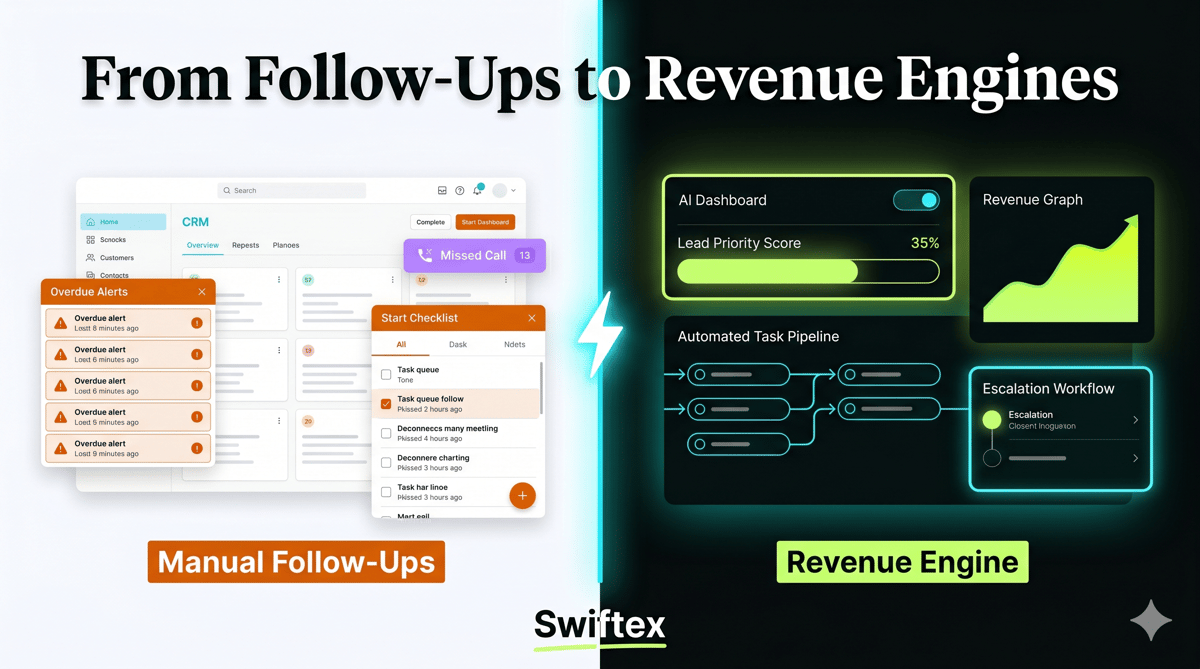
Modern CRM platforms are evolving from passive reminder systems into intelligent sales execution platforms. They no longer just store what happened — they analyze why it happened, predict what will happen, and initiate the next action without waiting for a human to decide.
This shift changes the economics of lead management. Instead of conversion being a function of rep bandwidth, it becomes a function of system intelligence.
|
Dimension |
Legacy CRM |
Intelligent Execution Platform |
|
Follow-up creation |
Manual, rep-dependent |
Automated on trigger / behavior |
|
Lead prioritization |
Date-based or manager-assigned |
AI-scored by engagement + intent |
|
Escalation handling |
Reactive, noticed too late |
Proactive, flagged before loss |
|
Reporting |
Static snapshots, manual pull |
Real-time, AI-generated insights |
|
Revenue attribution |
Last-touch / limited |
Multi-source ROAS + cost per conversion |
AI-driven task automation explained
At its core, AI-driven task automation removes the human decision layer from routine sales actions. When a lead fills out a form, the system does not wait for a rep to notice and assign a task. It reads the lead signal and creates the follow-up, the reminder, and the escalation path automatically.
This logic extends across the entire pipeline. If a lead was active last week and has gone silent, the system flags it. If a demo was scheduled and not attended, it triggers a rescheduling sequence. If a high-intent lead has been waiting 36 hours without contact, it escalates to a manager. All of this happens without a rep touching the record.
|
Behavioral triggers Tasks created automatically based on form fills, page visits, inactivity thresholds, and stage movement. |
Timed reminders Follow-up sequences set by lead activity patterns, not manually configured per contact. |
|
Automated escalation Overdue or untouched leads surfaced to managers before they impact pipeline health. |
Next-step generation Recommended actions at every stage based on engagement history and sales context. |
Intelligent lead prioritization
Not all leads are equal, and sales teams know this intuitively. The challenge is that without a system, prioritization defaults to whoever called last, whichever lead appeared most recently, or whatever the manager remembered to flag in the morning standup.
Intelligent lead prioritization replaces instinct with analysis. The system continuously evaluates each lead across engagement patterns, inquiry type, response history, time in funnel, and real-time interaction signals. It builds a conversion probability score that updates dynamically as the lead moves through the pipeline.
Sales reps start the day knowing exactly which leads to contact first because the system has already analyzed the full dataset and surfaced the highest-probability opportunities at the top of their queue.
|
SIGNALS USED IN INTELLIGENT PRIORITIZATION
|
Automated escalation and accountability
One of the most common revenue leaks in sales operations is the untouched lead. A contact enters the pipeline, is assigned to a rep, and never receives a follow-up. Without an escalation system, these leads simply age out. The rep moves to fresher contacts. The lead goes cold. The opportunity is lost and often untracked.
Automated escalation workflows close this gap by continuously monitoring pipeline health. When a lead has been inactive beyond a defined threshold, or when a follow-up task has passed its due date without being completed, the system surfaces the record to a supervisor before the opportunity is lost.
This creates a new layer of operational accountability that does not depend on managers reviewing CRM reports manually. The system identifies the problem; the human resolves it.
Accountability in sales should be built into the system, not left to someone reviewing a spreadsheet on Friday afternoon.
Real-time analytics and executive dashboards
Knowing what happened is different from knowing why it happened and what to do next. Real-time sales productivity analytics bridge that gap by giving teams complete, continuously updated visibility into every dimension of pipeline performance.
What real-time analytics tracks
- Response time: average hours from lead to first contact
- Task completion rate: percentage of follow-up tasks completed on time
- Overdue rate: volume of leads past their follow-up window
- Rep performance: individual conversion rates and activity benchmarks
- Campaign contribution: which sources drive actual closures
Executive overview dashboards bring this data into a single unified interface for leadership teams. Leads, conversions, revenue trends, campaign performance, outlet productivity, and operational KPIs are visible in one place without waiting for weekly reports or manual data consolidation from multiple systems.
The value is not just convenience. It is the ability to detect and correct performance issues in real time, not retrospectively.
AI-powered reporting and ROAS intelligence
Traditional sales reports describe what happened. AI-powered reporting systems diagnose why it happened and prescribe what should change.
Multi-source channel attribution
Not all leads arrive through the same path. AI-powered reporting analyzes both direct and indirect lead channels to identify which acquisition sources are actually contributing to conversions, not just which sources generate volume.
ROAS analytics and campaign profitability
ROAS analytics connects advertising spend directly with lead conversions and revenue outcomes. Instead of reporting impressions or cost-per-lead in isolation, the system maps the full path from campaign spend to closed revenue. Marketing and sales teams can see, for every rupee or dollar spent, what came back as actual converted business.
Lead conversion cost analysis
Advanced lead conversion reports help organizations understand the true cost of acquiring a customer by combining marketing spend, sales effort, follow-up activity volume, and conversion performance into a single cost-per-acquisition figure that accounts for the entire funnel.
Product and outlet performance
AI-based analytics identify which products or services are generating the highest engagement and revenue contribution across campaigns and regions. Outlet and branch analysis continuously monitors conversion rates, follow-up efficiency, and campaign effectiveness across locations, surfacing underperformers before they become a structural problem.
Autonomous decline detection
AI systems analyze factors including low lead quality, delayed responses, declining campaign performance, weak outlet productivity, and poor conversion trends to automatically surface the root causes behind revenue drops without waiting for a manager to investigate.
How Swiftex powers the revenue engine
Swiftex is purpose-built for the exact problems described in this article. As an agentic mid-funnel automation platform, Swiftex sits in the gap between demand generation and CRM conversion, the part of the funnel where most manual systems break down.
Swiftex brings together automation, analytics, AI-driven reporting, campaign intelligence, predictive insights, and sales productivity tracking into a unified revenue intelligence ecosystem. Businesses using Swiftex do not just manage their pipeline more efficiently. They transform it into an active, self-optimizing system that identifies opportunities, responds to them, and learns what drives results.
Frequently Asked Questions
What is AI-driven sales task management? +
AI-driven sales task management automatically creates follow-ups, reminders, escalations, and next-step actions based on customer behavior, lead activity, and sales stage movement. It removes the dependency on manual effort and ensures every lead receives timely, consistent attention.
How does intelligent lead prioritization work? +
Intelligent lead prioritization analyzes engagement patterns, inquiry types, response history, and real-time customer interactions to rank leads by conversion potential. Sales teams focus effort on the highest-probability opportunities at the top of their queue, not whoever called last.
What is automated escalation in sales? +
Automated escalation workflows identify untouched leads, overdue follow-ups, and inactive opportunities before they impact conversions. The system flags these records for manager review or reroutes them to alternate channels automatically.
What metrics does a revenue intelligence dashboard track? +
A revenue intelligence dashboard tracks response times, task completion rates, overdue activities, follow-up efficiency, salesperson performance, ROAS, lead acquisition cost, outlet productivity, and campaign contribution to conversion, all in a single real-time interface.
What is ROAS analytics in lead management? +
ROAS (Return on Ad Spend) analytics connects advertising expenditure directly with lead conversions and revenue outcomes. It maps the full path from campaign spend to closed revenue, helping businesses measure the true profitability of each campaign rather than just surface-level metrics.
How does AI detect the reasons behind revenue decline? +
AI-based reporting systems analyze factors including low lead quality, delayed response times, declining campaign performance, weak outlet productivity, and poor conversion trends to automatically surface the root causes behind revenue drops before they show up on a monthly review.
What is agentic mid-funnel automation? +
Agentic mid-funnel automation bridges the gap between demand generation and CRM conversion by autonomously executing follow-ups, escalations, prioritization, and sales tasks. It transforms passive pipeline data into active revenue actions without requiring constant human intervention.
Stop managing follow-ups. Start closing revenue.
Swiftex is an agentic mid-funnel automation platform that automates sales follow-ups, prioritizes leads with AI, escalates overdue opportunities, and delivers real-time revenue intelligence across your entire pipeline.