In This Article
- Why the labels worked, once
- Five ways the labels fail
- Stage and intent are not the same thing
- What goes into an intent score
- What changes when you act on a score
- What to keep from stages
- How to start
- FAQs
It’s 9 AM and a sales rep has two leads in front of them.
The first is marked Hot. It came from a showroom enquiry form six days ago and hasn’t replied since. The second is marked Cold. It came from an ad, and at 10:40 last night the buyer asked about on-road price, EMI on the top variant and whether Saturday works for a test drive.
Most CRMs put the first lead on top. The label says so. The buyer says otherwise.
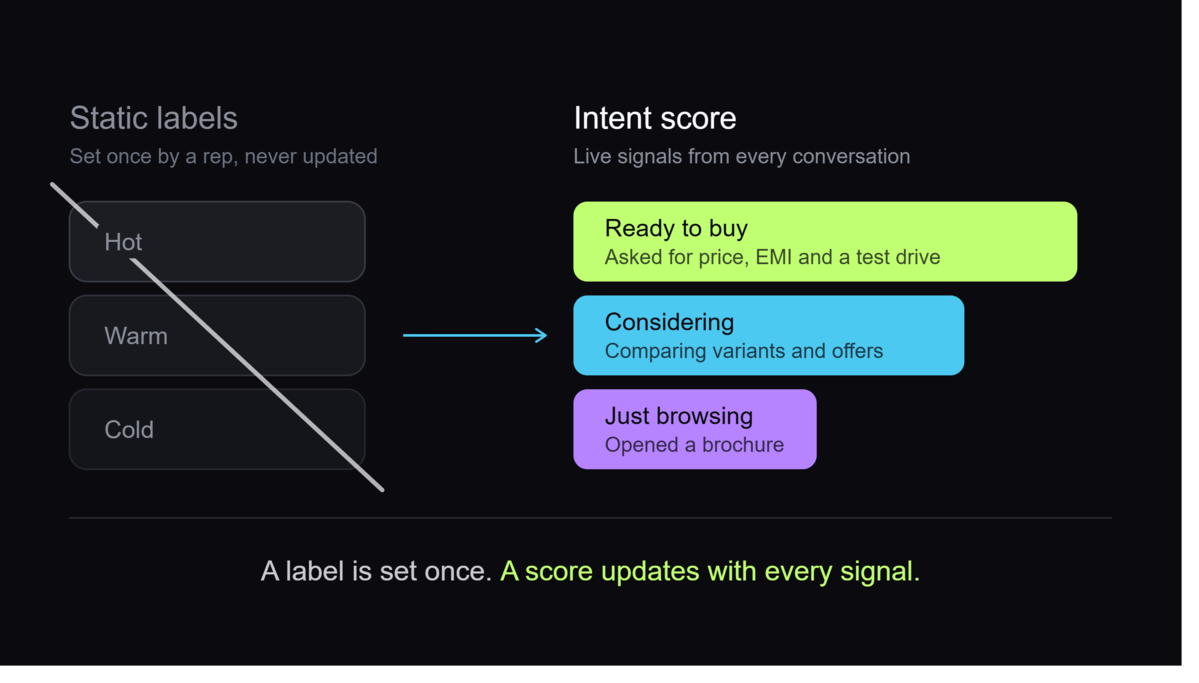
Hot, warm and cold are opinions someone recorded once. An intent score is a measurement that keeps updating. That difference decides who gets called first, and who quietly goes to another dealer.
Why the labels worked, once
When a rep handled a few dozen leads, memory did the prioritising. Today leads arrive from ads, portals, WhatsApp, calls and forms, all day and night. No one can hold that in their head, so teams compress it into three words.
Five ways the labels fail
- A person assigns them. Two reps will tag the same lead differently, and many labels simply follow the lead source.
- They never decay. “Hot” on Monday is still “Hot” on Saturday, even if the buyer went silent on Tuesday.
- They are too coarse. When 300 leads are “hot”, you don’t have a priority. You have a pile.
- They follow source, not behaviour. A showroom form fill is not proof of intent. What the buyer says and does is.
- They fulfil themselves. Cold leads don’t get worked, so they never get the chance to prove they were warm. In many funnels, follow-ups stop at the second attempt, long before many buyers are ready to decide.
Stage and intent are not the same thing
A lead can sit in “Contacted” for ten days and be ready to buy today. Stage describes what your team has done. Intent describes what the buyer is doing. Most teams use the first to answer a question that only the second can answer.
What goes into an intent score
- What the buyer says: budget, model or variant, finance and exchange questions, test drive requests
- What the buyer does: reply speed, call pickup, repeat visits, brochure and price views
- Recency: scores fall when signals go quiet
- Enrichment: context from your CRM, DMS and other data sources
- Negative signals: long silence, opt-outs, competitor-only research
What changes when you act on a score
The buckets become a ranked list. Buyers with high intent go straight to a rep, with the full transcript and score attached. Lookers stay on nurture until they show something new. The rep’s morning starts with the lead most likely to buy, not the one who came in last.
|
|
Hot / Warm / Cold |
Intent score |
|
Who decides |
The rep, or the lead source |
Signals from conversation and behaviour |
|
Updates |
When someone remembers |
Continuously |
|
Detail |
3 buckets |
A ranked list |
|
Based on |
Opinion and channel |
Observed buyer actions |
|
Drives action |
Loosely |
Directly: call now, nurture, escalate |
|
Improves over time |
No |
Yes, with outcome feedback |
What to keep from stages
Stages still matter. They show ownership, process and reporting, and managers need them. The better model uses both: stage for where a lead is, score for how ready the buyer is.
Scores come with a condition. They have to be explainable, with reasons a rep can read, and checked against real outcomes. A score nobody trusts is just a fancier label.
How to start
- Audit your labels. Compare “hot” leads against what actually converted last quarter.
- List the signals you already capture. Chats, calls, replies, site visits.
- Set score bands and attach an action to each. Call now, send details, nurture.
- Feed outcomes back in. Every sale and every loss should sharpen the next score.
The goal isn’t to remove judgement from sales. It’s to stop asking reps to guess which of 300 leads to call first.
Frequently Asked Questions
What is an intent score? +
A live number that estimates how ready a buyer is, based on what they say and do.
How is it different from a lead score? +
Traditional lead scores often award fixed points for fit or source. Intent scores update with every new signal.
Is hot/warm/cold classification outdated? +
It struggles at volume because it is manual, static and coarse.
Do I still need lead stages? +
Yes, for process and reporting. Use scores alongside them, not instead of them.
How often should intent scores update? +
With every new interaction, and they should decay when signals go quiet.
Let every conversation score itself
Swiftex reads every conversation across WhatsApp, voice and email, scores intent in real time and escalates only sales-ready buyers to your team, with the full transcript, score and next best action attached. Everyone else stays in nurture until something changes.