In This Article
- Where does dealership lead leakage actually happen?
- Why does WhatsApp make leakage harder to see?
- The playbook: seven stages from first message to test drive
- Where leaks show up and what closes them
- What should Sales and Contact Centre leaders measure?
- How do you roll this out across a dealer network?
- Where does Swiftex fit in this playbook?
Where does dealership lead leakage actually happen?
Lead leakage is the loss of a genuine enquiry somewhere between the first message and a completed test drive. It is rarely one big failure. It tends to happen at handoffs: from the OEM site or portal to the dealer, from the dealer to a sales consultant, from a first reply to a real conversation, and from a booking to a showroom visit.
For a Sales and Planning head, this shows up as conversion that varies from one dealer to another with no visible cause. For a Contact Centre or Digital Sales head, it shows up as enquiries that were answered but never became appointments. Both are looking at the same problem from different ends of the funnel.
Why does WhatsApp make leakage harder to see?
Buyers in India are comfortable on WhatsApp. It is quick, familiar and informal, which is why it works well for early conversations about a car. The difficulty is where the conversation lives. When a thread sits on a consultant's personal phone or in a separate inbox, it sits outside the lead record and outside the CRM.
A manager cannot see how long the first reply took. A teammate cannot pick up the thread if the consultant is on leave. Nobody can tell whether a test drive was ever offered. The channel is not the problem. The missing link between the chat and the lead record is.
The playbook: seven stages from first message to test drive
This playbook follows the lead's path from the first WhatsApp message to a completed test drive. Each stage is built around a handoff where leads commonly slip, so every step closes one specific gap. They work best as a connected sequence, because a fast reply at stage two is wasted if there is no clear slot offer at stage four.
Stage 1. Bring every enquiry into one lead record
Leads arrive from the OEM website, the brand app, third-party portals, click-to-WhatsApp ads, calls and walk-ins. Give each customer one lead record, merge duplicates, and keep the source visible. The WhatsApp conversation should attach to that same record from the first message.
Stage 2. Start a response clock and set a first-response standard
Agree a first-response standard for each source and for in-hours and out-of-hours enquiries. Choose a standard the network can actually meet, based on current performance, and tighten it over time. Send an immediate acknowledgment, then make sure a useful reply follows inside the standard. If the clock runs out, escalate to a team lead or the next available consultant.
Stage 3. Qualify inside the conversation
Ask only the questions that decide routing and priority: model and variant of interest, buying timeline, exchange vehicle, finance need and preferred outlet. Ask one or two at a time and save the answers to the lead. Customers who are asked to repeat themselves, or to fill a long form, tend to go quiet.
Stage 4. Offer a test drive slot, not a callback
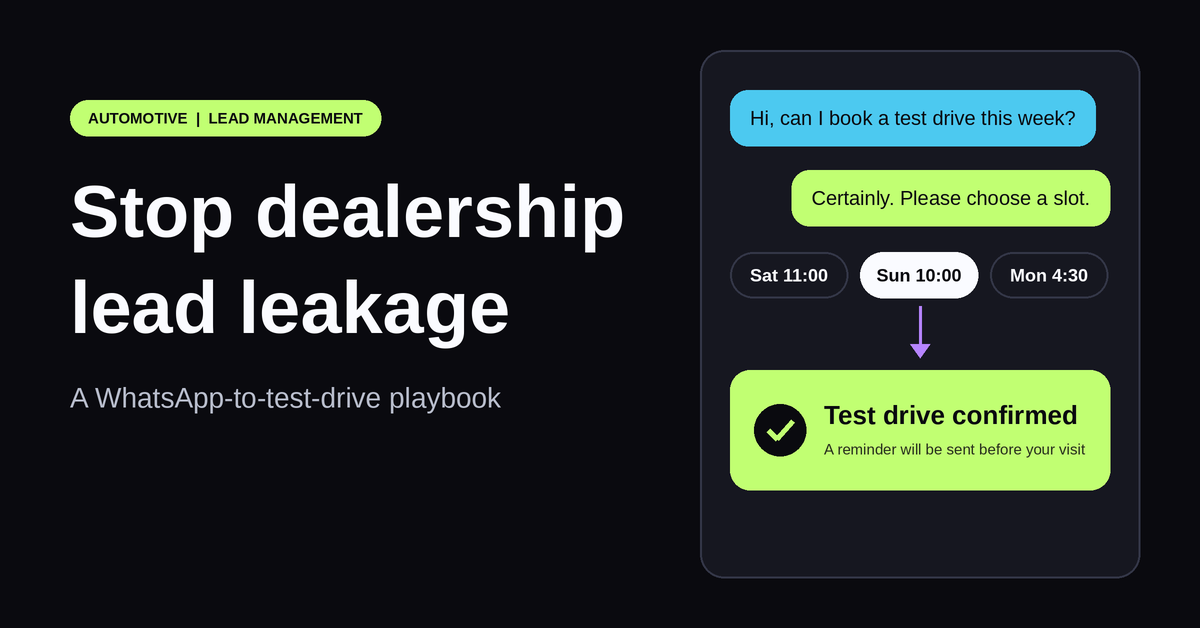
Share specific slots for the customer's preferred outlet and let them pick one in the thread. A callback adds a delay and a second chance for the lead to cool off. A slot gives the customer something concrete to say yes to.
Stage 5. Confirm and remind
Send a confirmation with the showroom address, a location pin and the consultant's name. Send a reminder before the visit, and make it easy to reschedule. A simple change of plan should not turn into a lost lead.
Stage 6. Follow up no-shows and silent leads on a defined path
Set a short, clear follow-up path for customers who miss a booking or stop replying. Define when it stops, such as when the customer replies, books, or opts out. Hand the conversation to a person as soon as the customer shows strong intent or asks a specific question. Use WhatsApp only for customers who have opted in, and follow the platform's template rules.
Stage 7. Record the outcome and close the loop
Every lead should end with a recorded outcome: test drive completed, booked, lost with a reason, or not reachable. Without it, neither the dealer principal nor the OEM can see why leads were lost. With it, dealer scorecards and network reviews rest on facts rather than impressions.
Where leaks show up and what closes them
Use this table as a quick audit. If you recognize more than two or three of the middle column in your network, start with those rows.
|
Leak point |
What it looks like |
What to put in place |
|
Source to dealer handoff |
Leads from the OEM site, portals and ads reach the dealer late or reach the wrong outlet |
One lead record per customer, routed by city and model, with the source preserved |
|
First response |
The enquiry waits until a consultant is free, or until the next morning |
A response clock per lead, an immediate acknowledgment, and escalation when the standard is missed |
|
Conversation on a personal phone |
The WhatsApp thread lives outside the lead record and cannot be reviewed |
Conversations attached to the lead timeline so managers and teammates can see them |
|
Qualification |
Long forms or repeated questions cause the customer to go quiet |
Two or three short questions asked in the chat, with answers saved to the lead |
|
Test drive offer |
The customer is told someone will call back, and the momentum is lost |
Specific slots offered in the thread for the customer's preferred outlet |
|
Booking to visit |
No confirmation, no reminder, and no easy way to reschedule |
Confirmation with address and consultant, a reminder, and a simple reschedule path |
|
No-show and silent leads |
Follow-up depends on individual memory and stops after one attempt |
A defined follow-up path with clear stop rules and a human handoff on intent |
|
Outcome capture |
Leads close with no reason recorded, so the OEM cannot see why they were lost |
A required disposition on every lead, feeding dealer scorecards |
What should Sales and Contact Centre leaders measure?
Measure the journey in steps, so a drop can be traced to a stage. Take a baseline before changing anything, and compare each dealer against its own starting point before comparing dealers with each other.
- Time to first response, by dealer, source and time of day
- Contact rate after the first attempt
- Share of qualified leads offered a test drive slot
- Test drives booked per qualified lead
- Show rate for booked test drives
- Share of leads closed with a recorded outcome
How do you roll this out across a dealer network?
A network-wide change does not need to begin as a large project. A contained start gives you evidence and a working standard before you ask every dealer to change how they work.
- Pick one lead source and a small group of dealers with different levels of performance.
- Record the current baseline for the six measures above.
- Agree the first-response standard and the test drive slot process with those dealers.
- Attach the WhatsApp conversations to the lead record so they can be reviewed.
- Review the measures every week and fix the weakest stage first.
- Extend to more sources and dealers once the standard holds.
Where does Swiftex fit in this playbook?
In a small network, parts of this playbook can run on spreadsheets and discipline. Across many outlets, the stages need to run the same way every day, and that is hard to sustain by hand.
Swiftex is an agentic mid-funnel automation platform built for the stretch between the first enquiry and the test drive. It keeps WhatsApp conversations on the lead timeline, applies response standards, supports slot offers and reminders, and runs follow-up and outcome capture so the gaps between stages are covered. The goal is a lead that is handled consistently whichever outlet or consultant receives it.
Key takeaways
- Lead leakage is usually a series of small gaps at handoffs, rather than one large failure.
- WhatsApp works well for buyers. The gap is that conversations often sit outside the lead record.
- Offer a specific test drive slot in the conversation instead of promising a callback.
- Define a follow-up path for no-shows and silent leads, with a clear point to hand over to a person.
- Record an outcome on every lead so dealer performance can be reviewed with facts.
Frequently Asked Questions
What is dealership lead leakage? +
Dealership lead leakage is the loss of a genuine enquiry between the moment a customer raises their hand and the moment a test drive is booked and completed. It usually happens through small gaps such as a slow first reply, a missed handoff between teams, a test drive slot that is never offered, or a no-show that nobody follows up.
Why do WhatsApp leads fall through even when dealers reply? +
A reply is only one step. When the conversation sits on a consultant's phone or in a separate inbox, managers cannot see response times, whether a test drive was offered, or what happened after the last message. If the consultant is unavailable, the thread is effectively unavailable too. The gap is the missing link between the chat and the lead record.
How fast should a dealership respond to a WhatsApp enquiry? +
There is no single number that fits every network. Start by measuring current time to first response by dealer, source and time of day, then set a standard the network can meet and tighten it over time. An immediate acknowledgment followed by a useful human or agent reply inside the agreed standard is a practical pattern.
How do you turn a WhatsApp enquiry into a booked test drive? +
Qualify with a few short questions inside the conversation, then offer specific test drive slots at the right outlet instead of promising a callback. Confirm the booking with the address and consultant name, send a reminder before the visit, and make rescheduling easy.
What should an OEM measure to see lead leakage across dealers? +
Useful measures include time to first response, contact rate after the first attempt, the share of qualified leads offered a test drive slot, test drives booked per qualified lead, show rate for booked drives, and the share of leads with a recorded outcome. Compare each dealer against its own baseline before comparing dealers with each other.
Can automation handle WhatsApp follow-up without hurting the customer experience? +
Routine steps such as acknowledgment, qualification questions, slot offers, reminders and no-show follow-up can be automated well when the messages are short, relevant and sent only to customers who have opted in. Conversations that show strong intent or a specific question should be handed to a person with the full history attached.
See where your leads are leaking
Book a 20-minute lead leakage review with Swiftex. We will map your WhatsApp-to-test-drive journey with your Sales and Contact Centre teams and show where leads drop between stages.