In This Article
- The standard nobody owns
- What the OEM can see today, and the three blind spots
- The blame loop, and what the record actually shows
- What one network-wide standard requires
- Why the layer sits above the network, not inside each dealer CRM
- Variance is the metric, not the average
- What to report monthly, and a 60 day pilot
The standard nobody owns
The OEM generates the demand. The dealer owns the conversation. Neither owns the standard in between.
This is a structural problem rather than a performance problem. A dealership is an independently owned business with its own payroll, its own sales manager and its own view of which enquiries are worth working. The OEM can set a target response time, publish it in the dealer handbook and review it quarterly. It cannot make anybody pick up the phone.
The usual instruments are weak for the same reason. Dealer scorecards report behaviour a quarter after it happened, by which time the enquiries are gone. Mystery shopping samples a handful of interactions and tells you about the sample. Training changes intent, not the queue that greets the advisor on Monday morning. Each one measures or advises. None of them intervenes at the moment the enquiry lands.
What the OEM can see today, and the three blind spots
Most OEMs can see enquiry volume by source and region, leads pushed to each dealer, and retail at the end of the month. That is enough to know the funnel is leaking and not enough to act.
Three things are usually invisible at network level:
- Whether the standard was met on the enquiries that mattered. Not the network average, but whether this specific high intent enquiry got a first attempt inside the window, on which channel, and by whom.
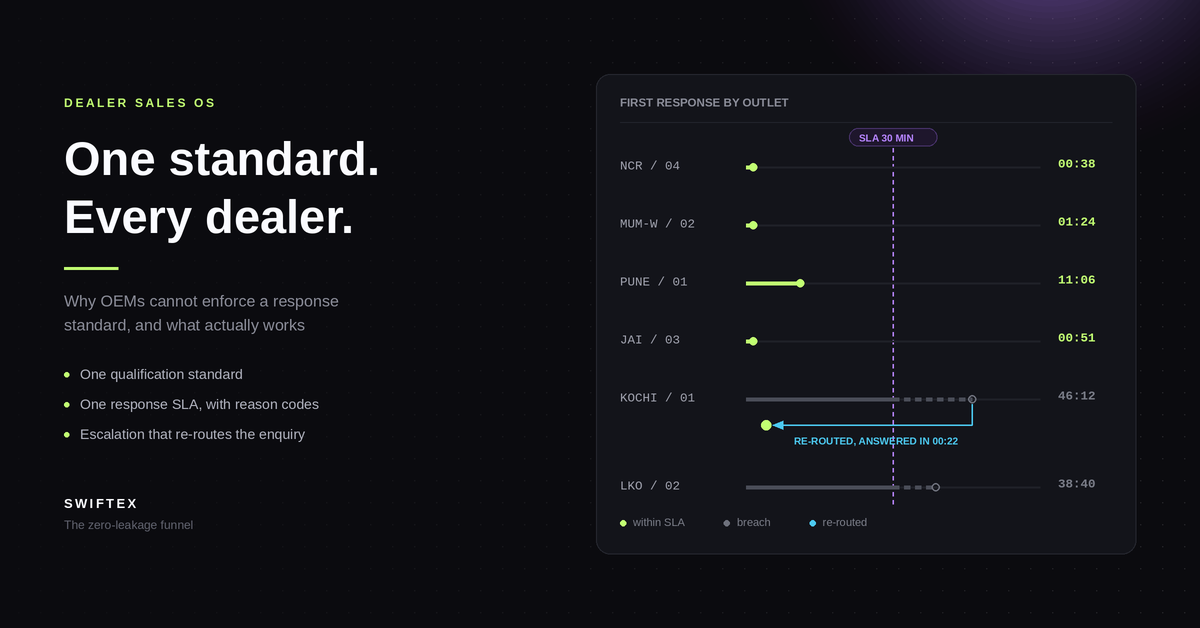
- Why a breach happened. A breach with no reason code is indistinguishable from neglect. Wrong pin code, stock unavailable, duplicate enquiry, invalid number and simply ignored all look identical in a volume report.
- What happened next. Enquiries that miss the window rarely get a second life. Nobody holds the list, so nobody works it.
Independent measurement suggests the ceiling is moving. Pied Piper’s 2026 Internet Lead Effectiveness study of dealership websites reported an industry average of 71 out of 100, up six points year on year, while response quality fell by around nine points when an enquiry needed genuine human involvement. The floor is improving and the hardest cases are still the weakest, which is exactly the gap a network standard has to close.
The blame loop, and what the record actually shows
In the absence of an evidence trail, every review meeting runs the same argument. Marketing says the leads were good. The floor says the leads were junk. Both sides are arguing from impression.
|
Dispute |
What marketing says |
What the floor says |
What the record settles |
|
Lead quality |
Scored intent was high at handoff |
Leads are unreachable and unqualified |
Contact rate by score band and by outlet, which separates lead quality from follow-up quality |
|
Response time |
The service level is 30 minutes |
We called and nobody answered |
Time to first attempt, number of attempts, channel used and reason code on every breach |
|
Test drives |
Enquiries were delivered on time |
Customers do not turn up |
Booked against show-up rate by outlet and slot type |
|
Lost deals |
The floor did not follow up |
Pricing and stock lost the deal |
Stage of drop-off with the last logged action and the reason recorded against it |
Once the record exists, the argument ends. That alone changes the tone of a regional review, and it is a prerequisite for enforcing anything.
What one network-wide standard requires
Four components. The order matters, because each one removes an excuse the next one depends on.
- One definition of a qualified enquiry, published and identical across every region, source and outlet, so nobody is scoring to their own rules.
- One response service level with mandatory reason codes. A breach without a reason code counts as a breach, which is what makes the reason codes get used.
- Scoring applied before the lead reaches the dealer, so the outlet receives a ranked and enriched enquiry rather than a raw row it has to triage itself.
- An escalation path with teeth. After a defined breach window the enquiry re-routes to another outlet or to a central team, and the buyer keeps the same conversation thread.
The fourth is the one that changes behaviour. A standard with no consequence is a request. A standard that reassigns the enquiry is a standard.
Why the layer sits above the network, not inside each dealer CRM
Dealer systems vary by outlet. Different CRM versions, different DMS configurations, different data hygiene, different levels of adoption from the sales floor. Any standard implemented inside those systems inherits that variance, and the outlets with the weakest data discipline are the ones the standard most needs to reach.
A layer above the network reads enquiries from every source before they are distributed, applies one scoring and qualification standard, engages the buyer directly on WhatsApp, voice and email inside the window, and hands the outlet a qualified buyer with full context. It writes scores, attempts and outcomes back into whatever CRM and DMS the dealer already runs. The dealer keeps their systems. The OEM gets one standard.
It also removes the excuse that the dealer was too busy. Where the first response is automated and instant, response time stops being a staffing question and becomes a routing decision the OEM controls.
Variance is the metric, not the average
Network average response time is a comfortable number and a misleading one. A strong metro cluster pulls the average into an acceptable range while the bottom quartile of outlets loses enquiries at a rate nobody reports upward.
Report the spread instead:
- Time to first attempt at the best outlet against the worst, not the mean
- Percentage of outlets inside the service level on the top scoring decile of enquiries
- Contact rate on high intent enquiries, by outlet, with the bottom quartile named
- Breach reason mix by outlet, which separates a stock problem from a follow-up problem
- Revival rate on enquiries that missed the window
The programme goal is not a better average. It is lifting the bottom quartile, because that is where the enquiries the OEM paid for are being lost.
What to report monthly, and a 60 day pilot
The monthly regional pack
- Outlets inside the response service level on high intent enquiries, ranked
- Breach count with reason code mix, by outlet
- Contact rate and test drive bookings per 100 scored enquiries, by outlet
- Show-up rate against bookings
- Enquiries re-routed or centrally worked after breach, and what they converted at
- Cost per qualified enquiry by source, replacing cost per lead
A 60 day pilot design
Run it on one region or one brand rather than the full network. Sixty days is enough to move response time and to read early conversion signal.
- Baseline the six metrics above for the 30 days before go-live, so the comparison is not retrospective
- Pick a mixed cohort of outlets, including two from the bottom quartile, since those are the ones the standard is for
- Publish the qualification definition and the service level to the pilot outlets before switch-on
- Switch on instant first response and pre-distribution scoring, leaving the dealer CRM and DMS untouched
- Turn on escalation in week three, once the baseline behaviour is visible
- Review weekly on response and contact rate, and at day 60 on test drives and retail
Key takeaways
- An OEM cannot mandate follow-up behaviour inside dealerships it does not employ, which is why scorecards and mystery shopping do not change it.
- A network standard needs one qualification definition, one service level with reason codes, scoring applied before distribution, and escalation that reassigns the enquiry.
- The standard has to live above the dealer systems, because implementing it inside them inherits their variance.
- Measure the spread between outlets rather than the network average, and target the bottom quartile.
Frequently Asked Questions
Why can an OEM not simply mandate a dealer response time? +
Because dealerships are independently owned businesses with their own staffing and priorities. An OEM can publish a target and review it, but it has no operational control over the queue an advisor works each morning. Enforcement has to sit in a layer the network cannot opt out of.
How is this different from a dealer scorecard? +
A scorecard reports behaviour after the enquiries are gone. A network standard intervenes at the moment the enquiry lands: it scores before distribution, responds inside the window, records a reason code on every breach and re-routes the enquiry when the window closes.
What does an OEM lead response service level need to include? +
A single qualification definition, a maximum time to first attempt, the channels that count as an attempt, mandatory reason codes on breaches, and a defined escalation action once the window closes.
Do dealers have to change their CRM or DMS? +
No. The layer sits above the network, reads enquiries before distribution and writes scores, attempts and outcomes back into the systems each dealer already runs.
How do you separate poor lead quality from poor follow-up? +
Compare contact rate and conversion within the same score band across outlets. If high scoring enquiries convert at one outlet and not at another, the variable is follow-up rather than lead quality.
How long before results show at network level? +
Time to first attempt moves within two to three weeks because it is a routing change. Contact rate follows shortly after. Test drive and retail effects read across a full sales cycle, usually 60 to 90 days.
Show us 1,000 of your network enquiries
Swiftex will show you which outlets missed the window, why, and what those enquiries were worth. It runs on top of the CRM and DMS your dealers already use.